Could this happen in Naija? Ahmed Mohamed is tired, excited to meet Obama
This week, the teenage inventor gained global attention after being
arrested for bringing a clock he made to his high school in Irving,
Texas
 Above all else, Ahmed Mohamed wants some sleep.Early Thursday afternoon, when he would be in school if he weren’t
suspended, he curled his 14-year-old frame on a quilted bed. Outside,
satellite television trucks loomed on the street, but he stayed hidden
in a curtained back room of the family home.On Monday, the teenage inventor stepped with his outsized sneaker on
the intersection of several American fault lines – Islamophobia,
technology, school violence – when he showed up at school with a
homemade clock that his teachers took for a bomb.In the days since he has become a a symbol and a civics lesson far
more complex than anything in his ninth-grade social studies class. He
has received a call from a Saudi prince, a tweet from President Obama and invitations to Silicon Valley. And he has slept a total of about eight hours.His parents immigrated from Sudan, but Ahmed’s rise to fame started in the most American way: he was the new kid at school in Texas.Last year he attended Sam Houston middle school, where everyone knew
him as the kid who makes crazy contraptions. His classmates brought him
electronics to fix and even bought some of his gadgets. He had an
identity. He was the Inventor Kid.A few weeks ago, though, he started his freshman year at MacArthur
high school. No one knew him. He was just a lanky brown kid with
thick-framed eyeglasses. So he did what he would have done at his old
school: he built something. A clock.As an object it wasn’t a beautiful thing, but his inventions never
were. They served a purpose. Once, for instance, he waterproofed the
electronics of a remote-controlled car so that it could run on land and
underwater. He used a broken USB cord and other spare parts to make a
phone charger he could carry around during the day, while his friends’
phones conked out.The clock, typically, was a mess of wires and circuitry. But it told the time.His alarmed teacher called the police. What followed – three days’
suspension from school, and an arrest by Irving authorities before they
closed the investigation – set in motion forces that Ahmed is now
struggling to comprehend. He sat on Thursday and pushed up his glasses
so he could rub his eyes. His family buzzed in the kitchen, eating a
traditional Sudanese lunch of beans and tomatoes.
Above all else, Ahmed Mohamed wants some sleep.Early Thursday afternoon, when he would be in school if he weren’t
suspended, he curled his 14-year-old frame on a quilted bed. Outside,
satellite television trucks loomed on the street, but he stayed hidden
in a curtained back room of the family home.On Monday, the teenage inventor stepped with his outsized sneaker on
the intersection of several American fault lines – Islamophobia,
technology, school violence – when he showed up at school with a
homemade clock that his teachers took for a bomb.In the days since he has become a a symbol and a civics lesson far
more complex than anything in his ninth-grade social studies class. He
has received a call from a Saudi prince, a tweet from President Obama and invitations to Silicon Valley. And he has slept a total of about eight hours.His parents immigrated from Sudan, but Ahmed’s rise to fame started in the most American way: he was the new kid at school in Texas.Last year he attended Sam Houston middle school, where everyone knew
him as the kid who makes crazy contraptions. His classmates brought him
electronics to fix and even bought some of his gadgets. He had an
identity. He was the Inventor Kid.A few weeks ago, though, he started his freshman year at MacArthur
high school. No one knew him. He was just a lanky brown kid with
thick-framed eyeglasses. So he did what he would have done at his old
school: he built something. A clock.As an object it wasn’t a beautiful thing, but his inventions never
were. They served a purpose. Once, for instance, he waterproofed the
electronics of a remote-controlled car so that it could run on land and
underwater. He used a broken USB cord and other spare parts to make a
phone charger he could carry around during the day, while his friends’
phones conked out.The clock, typically, was a mess of wires and circuitry. But it told the time.His alarmed teacher called the police. What followed – three days’
suspension from school, and an arrest by Irving authorities before they
closed the investigation – set in motion forces that Ahmed is now
struggling to comprehend. He sat on Thursday and pushed up his glasses
so he could rub his eyes. His family buzzed in the kitchen, eating a
traditional Sudanese lunch of beans and tomatoes.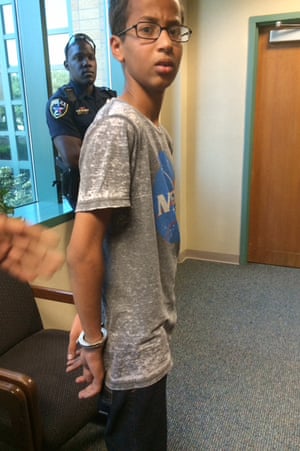 Ahmed Mohamed stands in handcuffs at Irving police department in Irving, Texas on Monday. Photograph: Eyman Mohamed/AP His voice came out as a croak.“It’s worth it, once you realize what you’re fighting for,” he said.And what is he fighting for?He looked around the room, and like any American 14-year-old
grappling with issues beyond his control, he answered with the rising
inflection of a question. “Not just for Muslims?” he said. “But for
anybody who has been through this?”Muslims have been through a lot in Irving. A controversy erupted here
in March, when Mayor Beth Van Duyne accused local mosque leaders of
attempting to set up a shadow court system, following Islamic law. The
imams said they were merely mediating minor disputes among adherents,
not bypassing or contradicting American law. Nonetheless, Van Duyne and
the Irving city council passed a resolution supporting a Texas “anti-sharia” bill.The atmosphere intensified. One local man recorded and posted video
of traffic outside mosques, and imams requested police security after
they said they received threats.“We actually have very good relations with local law enforcement,”
said Khalid Hamideh, spokesman for the Islamic Center of Irving. “But
the mayor is a crusader on the fringes of the far right, and
unfortunately there are some misinformed people who listen to her.”There’s a divide, in the Mohamed family, about religious
discrimination. The older generation say they have been treated well in
Irving. But their children – four girls and two boys, from toddlers to
teenagers – say they are increasingly regarded with suspicion and
disdain. One the sisters, for instance, said that she had to leave a new
job after her boss tried to force her to remove her hijab while at
work.After Ahmed’s arrest – all charges were dropped, but the school
suspension stuck – he found himself swept into the argument. The mayor,
for instance, publicly announced her support for the actions of the
school and police. Meanwhile, other organizations arrived to flank Ahmed
and his family, whether they wanted the support or not.Ahmed had attained symbolism. For example, when he was arrested he
was photographed in handcuffs wearing a N asaT-shirt, which was widely
noted across social media. Then, days later, he appeared on television
for interviews, alongside lawyers. He was again wearing the emblematic
shirt.By Thursday, the family had had enough of both sides. “No one
represents us. Not CAIR, not this place or that place,” said Eyman,
Ahmed’s 18-year-old sister, referring to the Council on American-Islamic
Relations.She seemed near tears. Her 17-year-old sister finished her sentence. “They don’t represent us. We represent ourselves.”Ahmed, in his curtained room, said he just wanted to keep making
things. “I’ve always had to reuse the parts to save money,” he said. He
picked up a laptop and sleepily pecked at the keys. Keeping up with
social media became impossible days ago.But he looks forward to meeting the president, he said, who had
invited him to bring his clock to the White House. But he can’t, just
yet, he said.“The police still have it.”
Ahmed Mohamed stands in handcuffs at Irving police department in Irving, Texas on Monday. Photograph: Eyman Mohamed/AP His voice came out as a croak.“It’s worth it, once you realize what you’re fighting for,” he said.And what is he fighting for?He looked around the room, and like any American 14-year-old
grappling with issues beyond his control, he answered with the rising
inflection of a question. “Not just for Muslims?” he said. “But for
anybody who has been through this?”Muslims have been through a lot in Irving. A controversy erupted here
in March, when Mayor Beth Van Duyne accused local mosque leaders of
attempting to set up a shadow court system, following Islamic law. The
imams said they were merely mediating minor disputes among adherents,
not bypassing or contradicting American law. Nonetheless, Van Duyne and
the Irving city council passed a resolution supporting a Texas “anti-sharia” bill.The atmosphere intensified. One local man recorded and posted video
of traffic outside mosques, and imams requested police security after
they said they received threats.“We actually have very good relations with local law enforcement,”
said Khalid Hamideh, spokesman for the Islamic Center of Irving. “But
the mayor is a crusader on the fringes of the far right, and
unfortunately there are some misinformed people who listen to her.”There’s a divide, in the Mohamed family, about religious
discrimination. The older generation say they have been treated well in
Irving. But their children – four girls and two boys, from toddlers to
teenagers – say they are increasingly regarded with suspicion and
disdain. One the sisters, for instance, said that she had to leave a new
job after her boss tried to force her to remove her hijab while at
work.After Ahmed’s arrest – all charges were dropped, but the school
suspension stuck – he found himself swept into the argument. The mayor,
for instance, publicly announced her support for the actions of the
school and police. Meanwhile, other organizations arrived to flank Ahmed
and his family, whether they wanted the support or not.Ahmed had attained symbolism. For example, when he was arrested he
was photographed in handcuffs wearing a N asaT-shirt, which was widely
noted across social media. Then, days later, he appeared on television
for interviews, alongside lawyers. He was again wearing the emblematic
shirt.By Thursday, the family had had enough of both sides. “No one
represents us. Not CAIR, not this place or that place,” said Eyman,
Ahmed’s 18-year-old sister, referring to the Council on American-Islamic
Relations.She seemed near tears. Her 17-year-old sister finished her sentence. “They don’t represent us. We represent ourselves.”Ahmed, in his curtained room, said he just wanted to keep making
things. “I’ve always had to reuse the parts to save money,” he said. He
picked up a laptop and sleepily pecked at the keys. Keeping up with
social media became impossible days ago.But he looks forward to meeting the president, he said, who had
invited him to bring his clock to the White House. But he can’t, just
yet, he said.“The police still have it.”
Comments
Post a Comment